 |
 Recommended Sites: Primedia Automotive Group | Popular Hot Rodding |
 |
 |
 |
 |
 |
 |
 |
 |
 |
 |
 |
 |




|
DUAL MODE
DYNAMITE By Jim
Campisano Installing a cat-back exhaust is always a dicey proposition for
magazine guys. In a lot of instances, the best you can hope for is a
couple of extra rear wheel horsepower and a genuine improvement in
sound quality. This isn't a knock on aftermarket cat-back systems,
it's just that the stuff Ford has used in its production cars over
the last few years is remarkably free-flowing. Heck, we're old enough to remember when bolting on aftermarket
mufflers was worth a serious increase in power. The factory stuff
was true junk. Not anymore. State of the art exhaust system
technology allows the OE guys to tune the sound of their systems
without sacrificing horsepower at all. The problem is when the
stories come out and the horsepower increases aren't what the
manufacturers' claims said they would be--like it's the fault of the
writer for the part's performance, not the manufacturer. Such is
life. That being said, when we were told the FR500 exhaust system sold
by Ford Racing Parts was worth 8-10 horsepower at the rear wheels we
started shifting in our chairs. I mean, we loved driving the FR500
Mustang at Road Atlanta a couple of years back. We were grateful
that some of the parts we sampled were finally hitting the Ford
Racing Catalog. Eight-to-10 horsepower from a cat-back system,
though? That's a bold claim. Could it be backed up? There's more to the FR500 exhaust than meets the eye. Under
normal loads, the exhaust gases go through the usual muffler baffles
to quiet the sound. Under heavy or full throttle, however, the gases
force open a trap door in the muffler, giving you a veritable
straight-through design--not to mention an insanely wicked sound.
They're called dual-mode mufflers. In addition, there is an X-crossover aft of the mufflers, which
increases torque while at the same time getting rid of some unwanted
resonance. The whole setup is 2.5-inch 409 stainless, with polished
tips. Sounds great, right? But how does it work in reality? To find
out, we enlisted the aid of Richard Howard, a police officer from
Clinton, N.J. During the day he patrols the mean streets of
Livingston, N.J.; afterwards, he cuts loose in a gorgeous new blue
2001 SVT Cobra. Now we were really up against it. If the system didn't work, we'd
have to worry about Ford Racing and a guy who carries a gun, a
nightstick and radar. Who said this job is all fun and games? Before we made the switch, Howard brought his car to Crazy Horse
Racing in South Amboy, N.J., for a session on the DynoJet. To his
(and our) delight, the car kicked out 274 rear wheel horsepower
and277 lbs.-ft. of torque. This was without a cool-down and very
close (at least horsepower-wise) to the car we tested from Ford in
the August issue. Next we met Howard at the Meineke muffler shop in Livingston.
Owner Sean O'Malley is as car crazy as anyone. Unfortunately, his
tastes run to silly little Bowties. At least he doesn't drive an
import, and he was more than happy to work on Howard's Cobra. Upon
viewing the Cobra from underneath, we were happy to see how easily
the old system could be removed. Unlike the factory system on solid axle cars, which usually have
to be cut off before the rear to facilitate removal, the pipes and
mufflers on the Cobra run under the independent rear. Removal was as
simple as unbolting a couple of clamps and popping the pipes out of
their rubber hangers. Installation was slightly more complex. The system bolted right
in, but the right side pipe ran too close to the vibration damper
affixed to the differential. Normally, you can use a large pry bar
and move it, but it was much less flexible thanks to the X-pipe. It took a little coaxing, but O'Malley finally had everything
lined up straight. We started the car and there were no leaks.
Officer Howard took it for a spin and loved the new sound. At idle,
it was actually pretty quiet, but at WOT, it had a nasty howl. Then it was back to the Crazy Horse dyno. The moment of truth.
Again, there was no cool down period; the only rest was while owner
Chris Winter tied the Cobra down. He made the pull and the results
were more than we could have hoped for. Howard's snake was now
producing 287.6 horsepower and (hold on) 292.2 lbs.-ft.of torque.
That's 13.6 hp and 15.1 lbs.-ft., sports fans. Best of all, it can be done in your driveway with the car
supported on jack stands. All you need is basic hand tools. This is
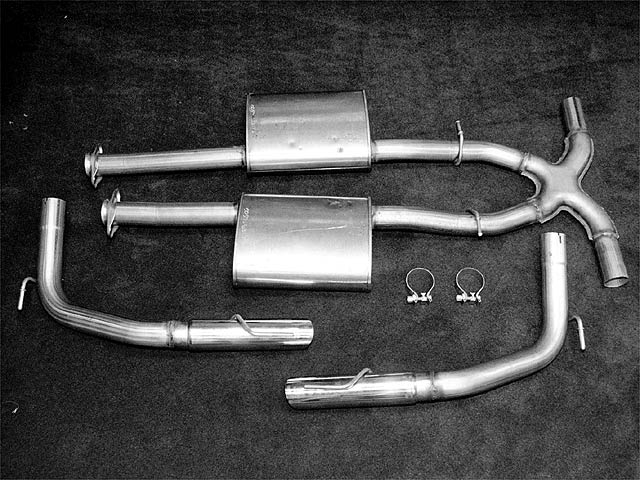
one exhaust story I didn't mind writing. The FR500 kit comes complete with
hangers, clamps, bolts, etc. The X-pipe aft of the mufflers
cuts down on resonance and adds a bit of torque. (Photo by
Frank Rizzo) This is Rick Howard. He carries a
badge. He also carries a gun, which had us hoping more than
usual that the parts we bolted to his car would work. They
did. Here's the stock Cobra exhaust
system. Note how close the right muffler is to the vibration
damper on the differential. The fact that it runs under the
IRS made removal a snap. We were somewhat relieved that the
stock system could be removed intact. That way if the FR500
exhaust didn't work, we could put it back on Patrolman
Howard's car without worrying about doing serious jail
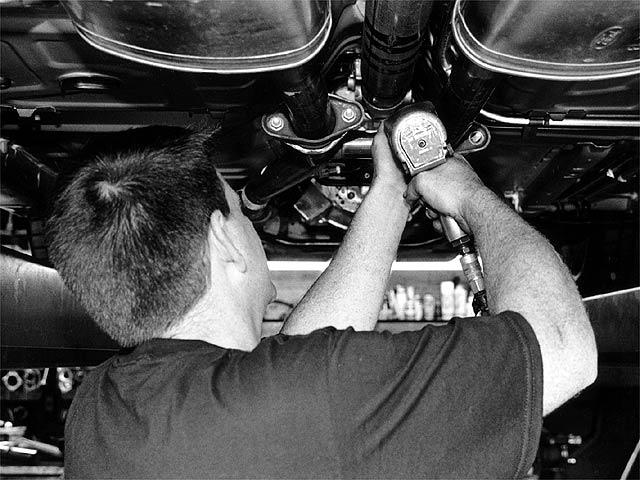
time. Sean O'Malley of Livingston Meineke
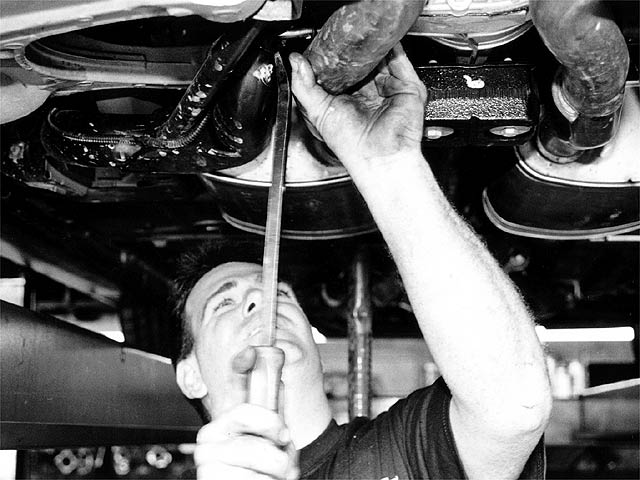
started by unbolting the clamps that held the stock cat-back
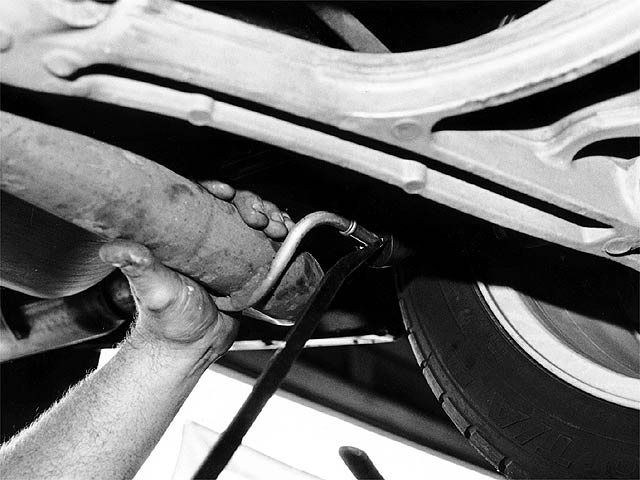
system to the factory catalytic H-pipe. O'Malley used a pry bar to release
the hangers from the factory rubber mounts. He did the one by
the tailpipe first and then the one by the IRS cradle. Each
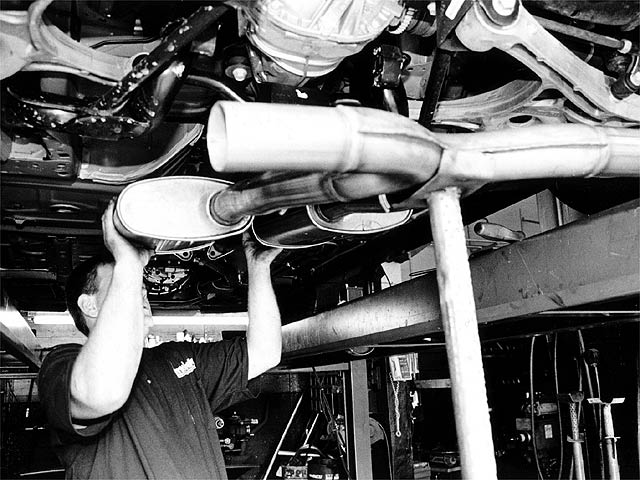
side gets removed individually. Using a pole jack to support the
rear of the setup, O'Malley lined up the dual-mode mufflers to
the factory H-pipe. Check out the special whiz-bang
tool specially designed for sliding steel hangers into rubber
exhaust system mounts. You don't need one for the job, but
O'Malley called it the greatest tool ever invented. He then
slipped the tailpipe hanger in, but this turned out to be an
incorrect move. The right side exhaust pipe was too
close to the vibration damper. Because of the X-pipe, there
wasn't a lot of play in the system, especially with the right
tailpipe in the hanger. The best thing to do is attach the
tailpipes, tighten the clamps and use them for leverage while
you pry on the pipe coming out of the muffler. With a little
muscle, we were able to get things lined up
fine. The tailpipes look great coming out
of the stock cutouts. The performance was even
better. Here's the "before" dyno graph. No
doubt, 274 horsepower from a stock Cobra is nothing to sneeze
at, nor is 277 lbs.-ft. of torque. Obviously, the horsepower
problems from '99 have been worked out. Of course, if 274 horsepower is
good, 287.6 is a lot better. And look at that torque curve.
We've never seen a car pick up 15 lbs.-ft. of torque from a
cat-back system
before. |






About Us | Privacy
Policy | User
Agreement
Copyright © 2002 by McMullen Argus Publishing, a Primedia Company.
All rights
reserved. Reproduction without our permission is strictly prohibited.